Affichage des articles dont le libellé est GEA. Afficher tous les articles

vendredi 30 mai 2014

GEA HY14 results

1) Intro

Note that the article is not self-supporting and will not make sense to a new reader (see my previous articles here 2012 , 2013).


GEA has published it's 2013 annual report and its 1stHY report:
- in the annual report the CEO warns clearly about a marked slowdown of sales in France, the need to focus on export markets, albeit at the cost of significant commercial investments and financial risks
- the CEO warns that it may impact profit margins
- 1stHY sales are down 25% compared to last year; down 50% in France, exports up 38%
- order book sharply down


I want to build a "worst case" scenario to decide what to do.
Besides, I previously compared GEA to Kapsch but Q-Free is maybe a better match (same size; Kapsch is much bigger, and builds but also operates whole/nationwide toll collection systems, a different business).
Q-Free 2013 revenue is the same as GEA.

2) What are GEA fixed costs ?

My current understanding of GEA business and financial situation is as follows:
- GEA designs the toll system (~100 engineers)
- I think it uses largely standard, off-the-shelf components (PLC, printers, card readers, audio and video systems, network components; fabrication of toll steel boxes is subcontracted, maybe they direcly manufacture some dedicated electronic cards) ; it's mainly integration and assembly, so no heavy equipment is needed (see below fixed assets). I wish I had the time to visit their plant near Grenoble.
 - ~100 people directly involved in production
- factory tests
- on-site installation
- maintenance and services

I think that if a downturn comes, GEA will be reluctant to significantly downsize its personnel (temporary staff aside) because:
- it would jeopardize future growth; GEA says in its annual report that the competence and stability of its people is important
- (supposition) not the style of this family-owned small company that thinks long term and not next year stock-options
- anyway long and costly (France labor market).

My main hypothesis is therefore that GEA has mainly variable costs, but that personnel expenses can be regarded as fixed costs, and it's a big part of expenses.

3) 2014 estimates

I've built the estimates with the preceding paragraph in mind and the following hypothesis:

- salaries: fixed cost
- all the rest: variable cost (not true of course)

- 1st hypothesis of 2014 sales~59 m€ (roughly double HY sales)
- 2nd hypothesis of 2014 sales~47 m€ (current order backlog)
- hypothesis that they will not needlessly build up their inventory and other costs
- I neglected amortization+depreciation in this simplified table, it's acceptable because it's generally low (see below)

Here is a table with data taken from the annual reports with my estimates.
Mat1ere = shorthand for "raw materials" expenses (in this case rather parts, components,...)
Autres achats = other expenses (go figure....)
Salaires = salaries
ROP = Operational result

I get a 2014 EBIT ~9-10 m€ in the (worst-case ?) scenario, a spectacular decrease compared to 2013.

But it would then trade at ~4 to 5x EBIT (for a quote of 87€), still a compelling valuation (because of the large net cash 60m€ for a 100 m€ market cap).


3) GEA competitive advantage
I've recently read this book The Little Book That Builds Wealth: The Knockout Formula for Finding Great Investments and liked it a lot; I will try to apply its concepts/ideas to the current situation.


GEA fixed assets are only ~ 1.2 m€ almost fully depreciated.
Much lower than Q-Free fixed assets though (see below). I have no explication for this.


It rents its buildings to another company...that belongs to the founding family/main shareholder, for what seems to me a reasonable price (see annual report).


Working capital is also very low; GEA pays its suppliers 30/60 days and negotiates payment terms with the customer (highway companies).

I've kept the actual denominations of the annual report (French version) for easy later reference.
Mat. 1ere = raw materials
en cours = inventory
creances clients = accounts receivable
dettes fournisseurs = accounts payable
dettes fiscales = fiscal debt
produits constates d'avance = prepaid income
BFR = working capital requirement


The capital employed (fixed assets + working capital) is thus very low.
About 5% of salaries can be considered as R&D costs, but are fully expended (R&D is not capitalized).
If I take assets at acquisition cost, add  5 years of R&D costs (arbritrary), ROCE is still very high.
Why is it not competed away ?

My understanding is that "local" actors (GEA in France, Q-Free in Norway, Kapsch in Austria,...) started early and small and ended dominating their national market (niche market).
I suspect that some kind of switching cost effect is at work there; for the highway company these actors provide a vital service, strongly integrated in the highway company process.
(Imagine the toll collection system down during summer vacations in southern France when half of Europe is en route from Netherlands/Germany/... to Italy/Spain/France...)


Besides from what I've read electronic toll collection investment pays for itself in less than 1 year.

So it makes probably little sense for a highway company to switch its ETC system from one to supplier to a cheaper competitor, unless there's a large price difference. Given the (small) size of the market, it's not just worth it for a competitor (again, a supposition). Additionally there is maybe (supposition) some notion of staff training (highway employees trained to do some basic maintenance on the toll machines) that reinforces this.

GEA benefited from this competitive advantage and an expanding market in France for structural reasons (highways companies going private investment cycle, see my previous article) but it is now apparently nearing saturation.

On the export markets, for new highways, I think that GEA has no clear competitive advantage (GEA "moat" is not scalable, lots of buzzwords here). Their strategy seems to accompany French construction companies (Bouygues, Vinci,...) on export contracts for new highways (see annual reports and also the red corner blog comments on GEA), but its unclear to me if it gives them some kind of commercial advantage on these markets.

5) Conclusion
I don't want to fool myself, and I'm the easiest person to fool.
I like GEA and I have invested some time (and  money) in this investment, but I want to remain cold and rational about this.
I'm certaintly not selling GEA at the current price.
I think a downturn is possible, but I think GEA is still an interesting investment with good long term prospects and favorable economics.
The stock is quite illiquid, and we may (or not) witness a spectular plunge if there's a knee-jerk reaction to weak HY results, maybe a buying opportunity.
I'd appreciate a reality check from outside investors.

vendredi 24 janvier 2014

GEA 2013 annual results

GEA published yesterday evening its annual results : link (in French only).
The presentation slides are interesting to get an idea of GEA business.
Previous posts on GEA: here and here.
The stock went up sharply today (+15%, 88.4 €).

A few comments
Sales are flat ; EBIT margin (operational margin to be precise) is up but GEA warns that it is exceptional and linked to the end of several contracts.


 The drop in backlog orders has -so far- not materialized itself. There's nothing in the press release or in the slides hinting at a future drop in sales ; the management insists on its export recent contracts. GEA does not seem to be much affected by the Ecotaxe Snafu.


The cash is boosted by a reduction of the working capital that was already apparent in the 2013HY accounts ; so again a one-off effect.

True to itself the management has decided to keep the cash to "stay independent" and "finance its investments and exports". However the dividend is up 40% (3.35 €/share).

The family owns 38 % of the capital. Michel Baule, an entrepreneur in polymers turned small caps investor, owns 15%. I see his presence (strong minority investor) as a positive development.

With 60 m€ net cash for a 106 m€ market cap, EV/2013 EBIT ~ 2 !
I see no excuse not to buy some more (and I did at the opening this morning).

A look at competitor Kapsch :


I did not spent enough time on this, but from what I understand the project-related part of the business can be quite volatile (problems in Poland and South Africa legal issues). So a good reminder that a mindless extrapolation of the past performance is dangerous...I guess it applies to GEA also.


dimanche 30 juin 2013

GEA : the signal or the noise ?

The title refers, of course, to the book by Nate Silver, that I'm currently reading.
The Signal and the Noise

I like the book a lot (even though the chapters about baseball are hard to follow if you don't know the game) and recommend it.

GEA has recently offered me a good opportunity to think about how to filter the signal from the noise.

The facts (as objectively as possible)
I covered the fundamentals of GEA in a previous post : here and here.


Recently GEA published its HY results (here, in French only).
Earnings are in line with the previous year.
Cash now amounts to 54 m€, for a market cap of 88 m€ (73 € last quote). 0 debt. So EV/2012 EBIT ~2, super cheap for a company with apparently strong margins in a niche market.


So I was tempted to add to my position (and I did, much higher than 73 € though).

But :
At the end of the news release, GEA announces a 57 m€ backlog, a dramatic decrease from 75 m€ last year, even though GEA says at the end of the release that new orders have been booked since, notably in export markets.

The stock started a rapid descent the next day :


I treated this as noise but the "market" apparently thinks otherwise, and it's causing me sufficient concern to revisit my decision and the process (or lack thereof) behind it.
I'll write it down here and it will be interesting to revisit here in a few months.

I guess that most of my readers will have been in a more or less situation and would like to hear their thoughts on how they treat such situations.

So, signal or noise ?

On this graph I've plotted the backlog and actual sales of GEA for the last few years.
It makes sense that backlog and sales are highly correlated.
Last time the backlog dropped around 2007, the sales did follow a few months later, although they dropped much less. And a one occurrence sample makes for poor statistics...


Hypothesis 1
Recent order book drop is a fluke; current valuation is a steal. Sellers are wrong. Buy.

Hypothesis 2
Recent order book drop is highly significant. It's an indication of a large future drop in sales. I'm the idiot for trying to "buy the dip".
After all, many recent infrastructure projects have been recently cancelled in France, not good for GEA business.

Moreover, management does not say anything about this, which shows a serious lack of communication and deserves a higher valuation discount rate.

If we correlate the order book and the sales, we could expect future sales to be around 50 m€.
It also seems possible to assume that the margin will decrease and revert to its long term mean (around 11%).

This means an EBIT of around 6 m€, so an EV/EBIT ratio of around 6, not exactly a nosebleed valuation either, and certainly not a reason to dump the shares as brutally as happened ?
At the last shareholders meeting, some shareholders tried to have a special dividend voted, but the owning family blocked this. So maybe some are considering that the large excess cash of GEA is locked out, and that it deserves an additional discount ?

Conclusion

I can't really make sense of this brutal drop, but I'm maybe missing something or fooling myself ? And after all value investing is not about trying to make predictions about next year earnings, but rather putting the emphasis on valuation. I think GEA is a bargain at current prices, but time will tell.

jeudi 31 janvier 2013

GEA 2012 annual results

GEA has published its 2012 results.
The financial report is available here (in French).


Margins remain high (23 % op margin); no tangible sign of "mean reversion" as was (and still is) my main concern.
Modest sales growth, stable order backlog.


The balance sheet remains rock solid (40 m€ cash, 0 debt).
Working capital requirement shows a marked increase (large increase in accounts receivable) but I see not cause for concern.

In my previous article I had mentionned that GEA was not part of the "Ecomouv" consortium implementing a new tax for trucks ; but according the the latest report GEA will be a supplier after all.

I had also mentionned that Sanef had bought the transport branch of Communication and Systems (CS group), a comparable company. Finally the branch has been sold for 15 m€, around 0.5x 2012 Sales, or 10x 2011 operational result.


All in all, nothing very new.
Positives : strong balance sheet, profitable, cheap (EV/current EBIT ~3)
Negatives : slow growth, some indifference to shareholders (no special dividend, no share buybacks).

I've bought some more shares.


jeudi 6 décembre 2012

Mises à jour rapides GEA, TES

Quelques mises à jour

GEA a publié son chiffre d'affaires du 4è trimestre : ici
Le CA 2012 est donc pratiquement stable par rapport à 2011.
Plutôt bon signe, mais j'attends les résultats 2012 pour voir si la marge se maintient.

Tessi  (ou ici en anglais) a fait l'objet d'un intéressant article sur ce blog US ici.
J'ai une petite remarque sur sa conclusion :
"With ’12 earnings estimated in the €30-31 million range, Tessi should generate close to €40 million in FCF, for a yield of 20.1%".

Tessi a donné quelques perspectives sur ses résultats 2012 ici.
En clair : le chiffre d'affaires sur 9 mois est en baisse (186 vs 193).


La branche marketing perd de l'argent et sera réorganisée (charge non récurrente de 1,5 à 2 m€)
Le CA de la branche CPR OR ne sera pas à la hauteur de celui du 2ème semestre 2011, mais la marge devrait rester élevée.
La branche Documents semble en légère croissance.
Avec des extrapolations plus ou moins hasardeuses, je m'attends donc à un RN de 20-25 m€ plutôt que 30 m€.

D'autre part, le PDG Marc Rebouah a déclaré à l'AMF en novembre 2011 pas mal d'acquisistions d'actions Tessi à 71-73 € (voir le site de l'AMF), donc plutôt bon signe ?

Enfin dans les résolutions proposées à l'AG (voir ici), la société envisage d'emettre des obligations pour un montant de 20 m€, ce qui me surprend, compte-tenu de la grosse trésorerie excédentaire de Tessi. Y a t'il une acquisition majeure en préparation ?

Comme d'habitude, je me tâte pour renforcer ou attendre un hypothétique trou d'air.


dimanche 16 septembre 2012

GEA

 1. Intro

GEA (ticker : GEA) manufactures highway toll equipment. In my area (Escota highway network, owned by Vinci Group), almost every automatic toll I see is badged GEA.

The company has already been covered by several bloggers, which will spare me time :
- Actions ordinaires entreprises extraordinaires : Here and here (in French)
- Trying to be like warren : Here (in French and partially in English)
- The Red Corner : here (in English) , a very interesting and impressive analysis. I've added the blog to my blogroll.


To sum it up :
- GEA currently (for a quote of 65 €) trades at EV/EBIT ~ 2x, PER ~ 9 (2011 results)
- 2011 operating margin 22% (before taxes), 2011 ROE 22 %
- 0 debt, 40 m€ cash for a market cap of 78 m€, no goodwill
- order backlog covers more than 1 year of activity,
-  low maintenance CAPEX requirements

The company supplies 85 % of French motorways and has sold its toll systems in 33 countries worldwide.

All this sounds too good to be true and of course the question is : why is it so cheap ?

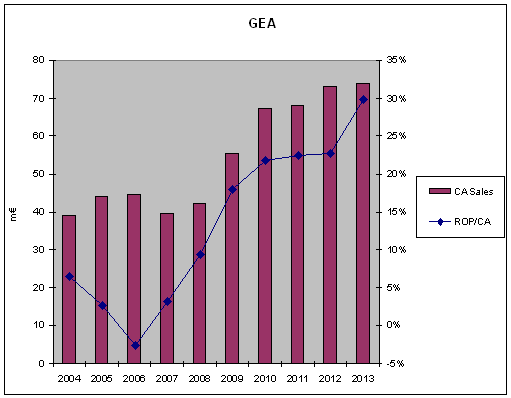
As pointed out by the Red Corner blog, there's a dramatic improvement of the business after 2007 (both sales and margins) : why ?


Another chart illustrating this (net result) :

The underlying issue of course is what will the future look like ? As pre-2007 (the current valuation is justified) or more like the recent years (then the current valuation is a bargain) ?

Second point : GEA is cheap because of its large cash position and absence of debt. Where will this cash go ?

2. Drivers behind the business improvement

I've read the annual reports but the management does not supply a clear explanation or I've missed it.
The Red Corner blog article  attributes this to international sales and a greater mix of services (maintenance,...) with a higher margin.


Here is what I found on my side.

What has driven the sales growth ?

Many highways went private in 2005 and embarked on an automatic toll collection program in the late 2000's. Here is an article giving the number of highway employees working in toll collection. The gain in productivity for highway companies is immediate and the return on this investment is quick.


Electronic toll collection  in French highways mainly relies on a DSRC (dedicated short range communication system) and a transponder or tag that is placed in the vehicle : Liber-t system in France (all highway operators use the same standard).

Other technologies have been developped (for instance satellite-based systems).
See for instance this neat presentation by Kapsch TrafficCom, a competitor of GEA (based in Austria)


For example according to this release, ~50 % of transactions on the APPR highway network are now made with this system and automatic transactions represent ~90 % of the total transactions. Almost all toll plazzas are now completely or partially automated.
So the market is probably saturated here.

In 2010 the highway companies signed with the Government a "green" investment program of 1 bn€ in exchange for a extended public concession time (so called "paquet vert" ="Green package") : article.  One of these investments is the immediate deployment of a 30 km/h drive-though toll in dedicated lanes; cars and trucks won't have to stop and restart, which reduces CO2 emissions.
GEA will benefit from this (see for instance GEA presentation here).

In 2013 all trucks will have to pay taxes on the national roads and smaller departmental roads : see link here. Apparently the system  involves "free-flow" tolling using overhead gantries and an on board unit (OBU). However I do not see GEA appear in the list of the Ecomouv company partners).


Free-flow tolling is the logical next step for highways and GEA should benefit from that.


In this article, there is an interview of Grigori Zass, the son of the company founder Serge Zass (in French).
A few items roughly translated :
- CAPEX requirements are low (~300 k€) but about 5 % of the salaries can be considered as R&D investments (1-2 m€/year)
- we were late in developping a "free-flow" system ; it was a mistake because it's the future and competitors are ready
- the French market remains central for GEA : few new highways are expected, but toll systems have to be maintained, upgraded every 3-5 years and replaced every 10 years "We live from this renewal/evolution market"
- export markets are difficult, especially China (local suppliers tried to copy their products). The product is 1st launched/tested on the French market, then made available for export
- same trend towards automatization on international markets
- in France the market has concentrated (more on that later)

Margins


GEA does not provide a breakdown of margins by business segment but its competitor Kapsch does :


Double-digit operating margins for services, extensions,... (recurring part of the business), much more fluctuating for the new projects (one-time effects). But of course you can't have the first business without the second.

I think this explains GEA 2005 loss. The 2005 annual report (loosely translated) says "this year an unusually high number of new pluri-annual contracts have been started, which significantly impacted the (net) result. The (positive) effects will be felt in 3-5 years".

I think that GEA currently benefits from long-term contracts signed a few years ago when French highways embarked on a large automatization program. I think this will slow down but the overall trend is positive.

Competitors and comparables


Main local competitor is the transport branch of group "Communication et Systemes" : link.
The Sanef group (itself a subsidiary of Spanish Group Abertis) has recently made an offer to buy the transport branch of CS, for a yet undisclosed amount.

Another French competitor is Thales (apparently it's a little more complicated because Thales has collaborated with GEA in the past to produce tags). Toll collection is just one of the numerous activities of Thales.
Another one is Multitoll  apparently a former subsidiary of Ascom group (Swiss), now independent.
Other competitors I could identify are Kapsch (already mentionned), Q-Free, from Norway, and SICE from Spain.
Kapsch and Q-Free are listed companies, SICE and Multitoll apparently not.

 See below the operating margins of competitor Kapsch (the 2011 surge in sales is linked to a major contract in Poland)


 The 2004-2011 average operating margin is around 10 % for GEA, 13 % for Kapsch, 5 % for Q-Free
According to the 2011 CS annual report, operational result 1.4 /sales 31 m€ = 4.5 % for the transport branch.
Multitoll is privately owned  but you can find some info here. Operating margins are around 4.4 %.


So I don't think that the current margins of GEA (>20 %) are sustainable in the future.

3. What will happen to the cash ?

GEA has 40 m€ in cash and 0 debt. What will happen to this cash ? Will it go back to ordinary shareholders ?

GEA is a small familial company, founded in 1970. The founder has 33 % of outstanding shares and more than 50 % of shareholder votes.
In the annual reports I have seen no trace of golden parachutes, free shares, stock-options, special retirement packages and related stuff. Management salaries seem very reasonnable.

The company pays a dividend (current yield 3.4 %), but there is no notable share buy-back program.

In the above mentioned article, Mr Zass states that GEA went to the stockmarket in 1994 to find capital to fund its exportation effort and that GEA independence is fundamental : "we wanted neither to sell our company to a larger group or to be indebted to banks".
Given this state of mind, I hardly imagine GEA giving this cash back to shareholders as a special dividend or a major share buyback. I think that GEA would need this cash in case of a large export contract, because cash flow can be very negative during some phases of the contract ; see for instance the free cash flow of Kapsch.


4. Conclusion

Ce que l'on conçoit bien s'énonce clairement. Et les mots pour le dire arrivent aisément.

In my case, just the opposite. I spent a long time writing and deleting this paragraph, which shows that I have a hard time reaching a clear conclusion.
All the bloggers mentionned at the beginning are very positive about GEA.

I'm not sure at all about extrapolating GEA recent results in the future (but 2012HY results are good ; some slowdown in sales but strong margins).

On the other hand, GEA valuation is very low compared to its competitors Kapsch and Q-Free. 2011 EV/EBIT ratios are around 16 for these two.
In 2008 it was possible to buy GEA at 10 €/share, an incredible deal offered by Mr Market (with the benefit of 100 % hindsight). Is it too late now ?

Insider trading : some buying by the family mid-2010 at around 40 €, nothing since.

A very simple DCF valuation (perpetuity) :


So the current price (around 65 €) is consistent with these assumptions :
- 0 growth
- 10 % EBIT margin (reversion to the mean)
- around 13 % required return / discount rate.
So am I willing to "buy" this company with reasonnably conservative assumptions about its future, and a return of ~13 % ? Yes. Do I have a large margin of safety ? Not sure.

Disclosure : long GEA.